Termination of Employment: What the Courts Say — Webinar Recording
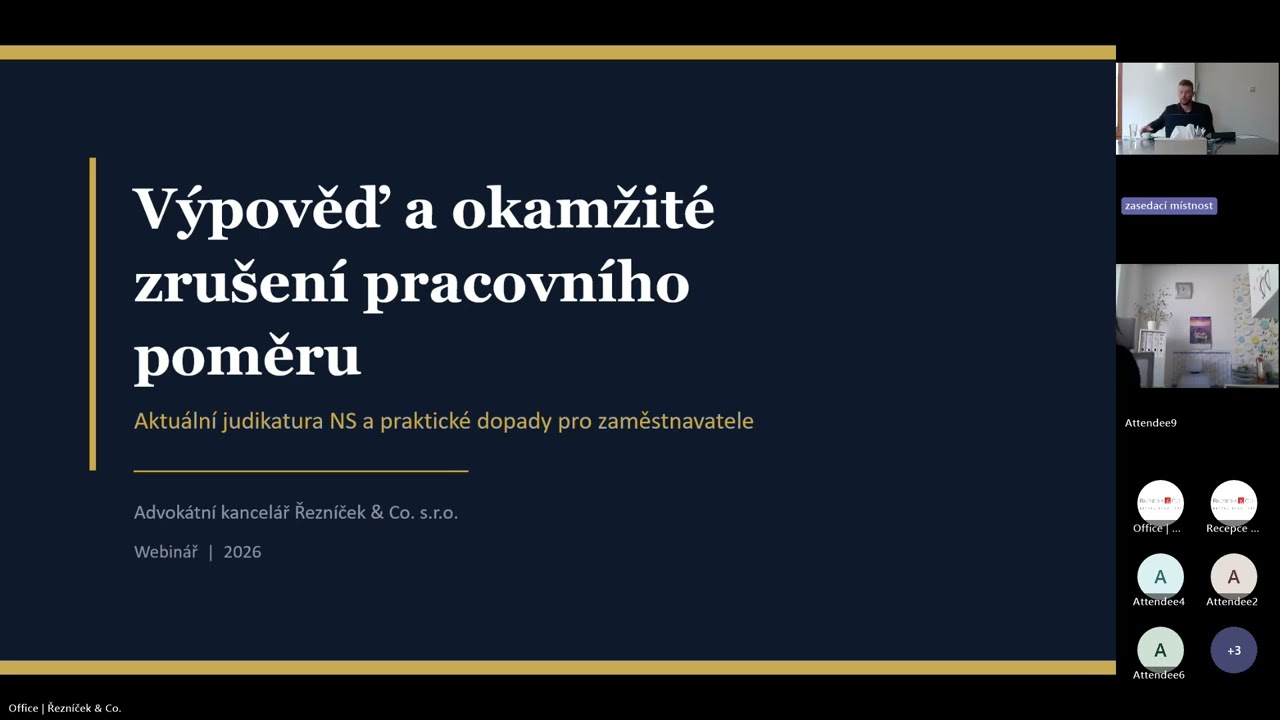
A practical webinar recording for HR staff, employers and managers. The key question: how to end an employment relationship so that it stands up in court.
Why we ran the webinar
Notice and immediate termination of employment are among the most common sources of disputes before the labour courts. In the vast majority of cases where the employer loses, the problem is not the substantive ground but the form — service, an insufficiently specific description of the conduct, or a time-limit someone „just managed“ to miss. The price is compensation of wages for the entire duration of the proceedings, often exceeding one year's salary.
In the recording we go through the current case-law of the Supreme Court and connect it with the specific steps an employer should take — and avoid — before issuing a notice at all.
What you will learn in the recording
Serving notice and immediate termination
- Why personal handover at the workplace is usually the safest route and when it pays to have a witness.
- Risks of postal service: deemed service, failed attempts, receipt by another person in the household.
- E-mail and data box — when yes, when no, and what formal requirements must be met for valid service under Section 334 et seq. of the Labour Code.
- Which date is decisive — drawing up, sending or receipt — and what this means for counting time-limits.
Grounds for notice (Section 52 LC) vs. immediate termination (Section 55 LC)
- The test of the intensity of the breach: less serious × serious × particularly gross.
- Borderline situations where notice still suffices and where immediate termination is appropriate.
- The most common errors in assessing seriousness — and how the court „rewrites“ them.
How to formulate the ground for termination correctly
- Specificity and non-interchangeability of the conduct — the case-law mantra on which most disputes fail.
- What exactly to put in the text, what to avoid, and how not to narrow the factual framework you will later need.
- What evidence to secure before issuing notice: witnesses, e-mails, photo documentation, attendance records, access logs.
Practical takeaways from the case-law
- Taking leave despite the employer's express prohibition.
- „Reporting“ work without actually being present — home office, fictitious tasks, pseudo-attendance.
- Time-limits for notice and immediate termination; the no-delay rule and what it means in practice in weeks.
- What recent Supreme Court decisions have changed in routine HR processes.
Questions and answers
Real questions from attendees in practice — from HR processes in manufacturing to managerial positions.
Who the recording is for
- HR staff and HR business partners who prepare materials for ending employment.
- Managing directors, directors and managers who sign terminations themselves.
- Businesses dealing with the departure of key employees.
- Trainee lawyers and in-house corporate counsel.
Webinar recording
Length: 1 hour 22 minutes.
Watch on YouTube: youtu.be/O2TC46bOlbM
Need a specific case assessed?
If you are dealing with the termination of a specific employee, get in touch. We will prepare the notice or immediate termination, assess the litigation risk and propose an approach that minimises exposure to wage compensation. Evaluating a specific situation usually takes 30–60 minutes of consultation.
Do you need legal advice?
We are ready to help you with any legal issue. Do not hesitate to contact us for a non-binding consultation.