Legal Requirements for Running an E-shop in 2026 — Webinar Recording
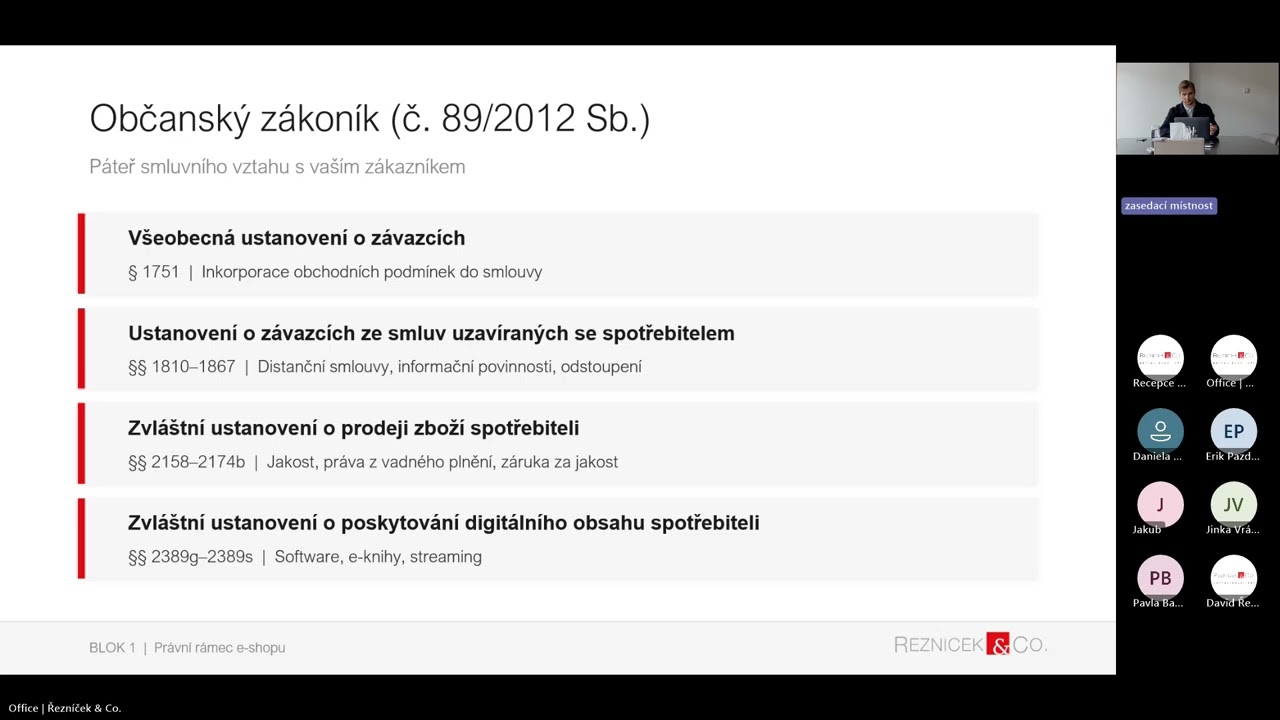
A practical webinar recording for e-shop operators, marketing managers and in-house lawyers. What changes in 2026, the fines that threaten for mistakes, and how to build an e-shop that withstands both a Czech Trade Inspection (ČOI) inspection and a consumer dispute.
Why we ran the webinar
E-shop practice has changed more in the last two years than most businesses realise. The Czech Consumer Protection Act and the Civil Code respond to European directives (Omnibus, DSA, the Modernisation Directive) — and the Czech Trade Inspection has meanwhile tightened both inspections and fines. Fines in the tens of thousands of crowns for a missing notice of the right of withdrawal or for improperly incorporated terms and conditions are no longer exceptional; in 2026 a further obligation is added that, without adjustments, can cost an e-shop hundreds of thousands.
In the recording we go through the legal framework step by step — from the basic obligations to the 2026 novelty, the mandatory button for withdrawal from a contract.
What you will learn in the recording
The legal framework of e-shops (from 5:41)
- The Czech laws and European directives that affect an e-shop: the Civil Code, the Consumer Protection Act, the GDPR, the Act on Certain Information Society Services, Omnibus.
- The hierarchy of rules and what to do when Czech and EU rules appear to conflict.
- When the DSA rules for online marketplaces apply to an e-shop and when they do not.
Terms and conditions: clear, comprehensible, properly incorporated (from 13:13)
- The three conditions the T&C must meet — otherwise they are not part of the contract and the court will disregard them.
- Click-wrap vs. browse-wrap: which form stands up and which fails.
- The most common mistake: T&C that are never actually made available to the customer at the moment of ordering.
Pre-contractual information duty (from 13:43)
- The complete list of mandatory pre-contractual information under Sections 1811 and 1820 of the Civil Code.
- How to structure the information so it passes the „clearly and comprehensibly“ test.
- Consequences of omission: extension of the withdrawal period by up to 12 months and ČOI sanctions.
The right of withdrawal and the model form (from 26:51)
- The 14-day period — when it starts, when it is extended, when it does not apply.
- Everything the withdrawal notice must contain.
- The model form — why it is mandatory and in what format you must provide it to the customer.
- Specifics for digital content, subscriptions and made-to-order goods.
2026 novelty: the mandatory withdrawal button (from 51:48)
- What the mandatory withdrawal button means in practice and how to implement it on an e-shop.
- Exactly where it must be placed and how it must be labelled.
- Risk: fines for the absence of the button can reach hundreds of thousands — the ČOI ranks this obligation among its inspection priorities for 2026.
- What to do if you run on a Shoptet/Upgates/Eshop-rychle template and cannot modify the checkout.
Who the recording is for
- E-shop operators and e-commerce company management.
- Marketing and product managers responsible for checkout and UX.
- In-house lawyers and compliance managers in retail.
- External advisers and consultants working with online sellers.
Webinar recording
Length: 57 minutes.
Watch on YouTube: youtu.be/cewtaC3KMW0
Need your e-shop reviewed?
If you are unsure whether your e-shop meets the current rules, get in touch. We carry out a legal audit of the e-shop — we go through the terms and conditions, pre-contractual information, checkout flow, complaints procedure and GDPR documentation. The output is a prioritised list of findings with specific adjustments. The audit usually takes 1–2 weeks depending on scope.
Do you need legal advice?
We are ready to help you with any legal issue. Do not hesitate to contact us for a non-binding consultation.